𝐒𝐢𝐧𝐠𝐥𝐢𝐬𝐡 𝐑𝐞𝐚𝐥𝐥𝐲 𝐈𝐬 𝐏𝐫𝐨𝐠𝐫𝐚𝐦𝐦𝐢𝐧𝐠 𝐋𝐚𝐧𝐠𝐮𝐚𝐠𝐞
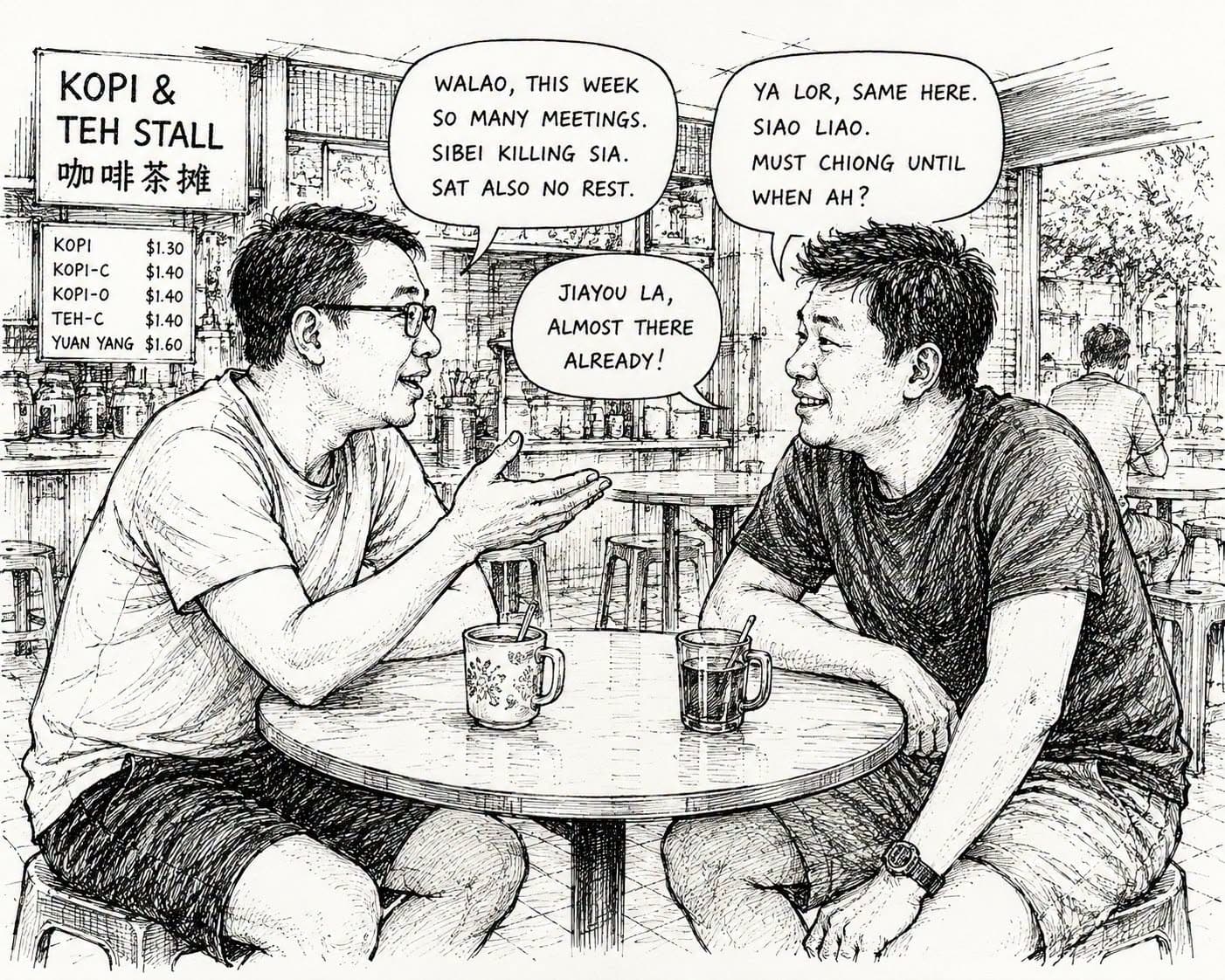
Yes - and that's the secret behind our ultra efficiency. We don't waste time spelling out the full thing.
Want to remove a file in Linux? That's just rf. No questions asked.
Singlish is the same. It's not broken. It's compressed.
If you listen carefully, Singaporeans spend much of their day speaking in something that resembles a programming language.
The most obvious example is ordering kopi.
I once had an ang mo friend who ordered like so: "Can I have an iced coffee with evaporated milk and no sugar?"
I simply went: "Kopi-C kosong peng."
Four words, got the job done.
The syntax is modular. Each component changes one attribute of the drink.
Kopi = coffee
C = evaporated milk
Kosong = no sugar
Peng = iced
See, it's not really a sentence. It is a command.
To the kopi uncle, I can imagine his brain compiling the instructions:
Coffee
+ evaporated milk
+ no sugar
+ ice
The remarkable thing is that Singaporeans instantly understand combinations they've never heard before because everyone understands the underlying rules.
𝐓𝐫𝐲 "𝐊𝐨𝐩𝐢-𝐎 𝐆𝐚𝐨. 𝐌𝐚𝐢 𝐓𝐧𝐠. 𝐌𝐚𝐢 𝐙𝐡𝐮𝐢." (𝐤𝐨𝐩𝐢-𝐨 𝐬𝐭𝐫𝐨𝐧𝐠, 𝐧𝐨 𝐬𝐮𝐠𝐚𝐫, 𝐧𝐨 𝐰𝐚𝐭𝐞𝐫).
You'll get strange stares, but it'll work.
In other words, kopi ordering is basically a command-line interface.
But the funny thing is that this kind of syntax appears everywhere in Singapore.
Take cai png.
In most countries, people describe what they want.
In Singapore, our 𝐜𝐚𝐢 𝐩𝐧𝐠 𝐨𝐫𝐝𝐞𝐫𝐢𝐧𝐠 𝐢𝐬 𝐫𝐞𝐚𝐥𝐥𝐲 𝐪𝐮𝐞𝐫𝐲𝐢𝐧𝐠 𝐚𝐧 𝐒𝐐𝐋 𝐝𝐚𝐭𝐚𝐛𝐚𝐬𝐞. We point.
"Rice. This one. This one. That one."
Entire transactions occur with almost no nouns.
The auntie understands perfectly. It is not a conversation. It is data entry.
The same thing happens when Singaporeans give directions.
The foreigner might say:
"Go down the East Coast Parkway and keep left. You'll see a gentle slope and a sharp turn. Carry on until you see what looks like an ERP and head towards it."
Singaporeans say:
"ECP. Rochor Exit. After ERP turn left."
Both take you to Suntec city.
Except the Singaporean's is a routing instruction.
Even our addresses work this way.
Ask a Singaporean where he lives and he might reply:
"Bedok 85." or "Block 431." or "Level 12 corner unit."
Each phrase contains a surprising amount of information.
Locals immediately understand, foreigners would just hear random numbers.
National Service might be the most advanced version of this language.
A sentence such as: "Last time Tekong I always kena RT after fail IPPT."
contains enough information for Singaporean men to reconstruct an entire life experience.
A foreigner would have no idea what was just said.
Then there are the famous Singlish particles.
Words like lah, lor, leh, meh and mah do something fascinating.
Consider the word: "Can."
By itself it means approval.
Add a particle and the meaning changes.
"Can lah."
Confident approval.
"Can lor."
Reluctant approval.
"Can meh?"
Doubt.
The factual content remains the same. The emotional operating mode changes.
In computer science, we understand that the particles function as metadata attached to the sentence.
Take queueing:
"Taken ah?"
"Last one?"
"You behind me?"
These are technically incomplete sentences.
Nobody cares.
The Singaporean's objective is not grammatical perfection. Our objective is efficient coordination.
Power boh?
We are so efficient, even our language waste no time. Chop chop curry pok.