𝐉.𝐁. 𝐉𝐞𝐲𝐚𝐫𝐞𝐭𝐧𝐚𝐦: 𝐓𝐡𝐞 𝐌𝐚𝐧 𝐟𝐢𝐫𝐬𝐭 𝐛𝐫𝐨𝐮𝐠𝐡𝐭 𝐭𝐡𝐞 𝐖𝐨𝐫𝐤𝐞𝐫𝐬 𝐏𝐚𝐫𝐭𝐲 𝐭𝐨 𝐧𝐞𝐰 𝐡𝐞𝐢𝐠𝐡𝐭𝐬
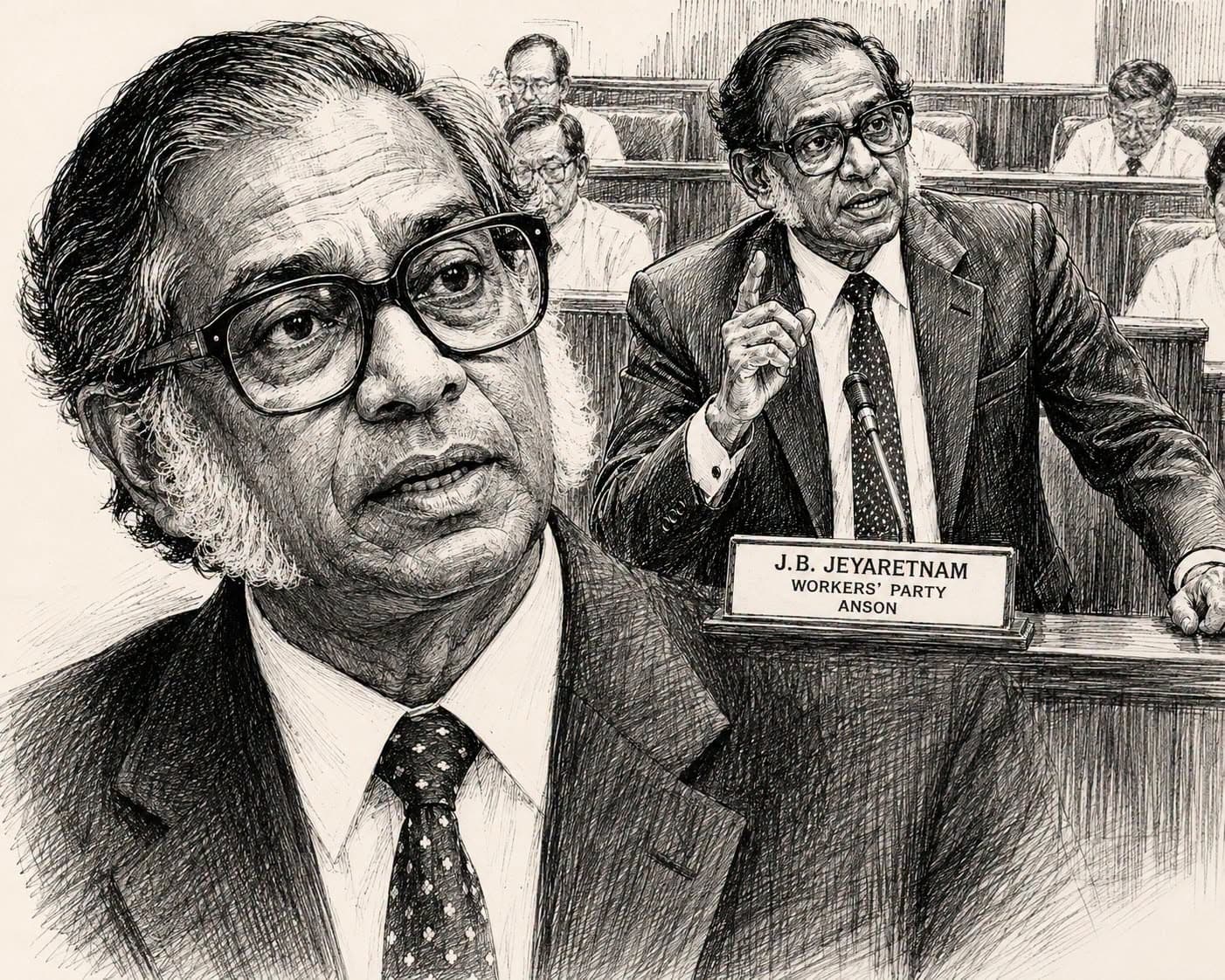
Everyone knows Pritam to be the minority leader of the Worker's Party. But he's not the first. Many have forgotten their fiery Tamil leader of the 20th century. Yes, we're talking about J.B. Jeyaretnam.
Few figures in Singapore's political history evoke as much admiration, discomfort, disagreement and fascination as Joshua Benjamin Jeyaretnam.
More than four decades after his famous Anson by-election victory in 1981, Singapore is still trying to decide what exactly J.B. Jeyaretnam represented.
𝐖𝐚𝐬 𝐡𝐞 𝐞𝐟𝐟𝐞𝐜𝐭𝐢𝐯𝐞 𝐢𝐧 𝐰𝐢𝐧𝐧𝐢𝐧𝐠 𝐠𝐫𝐨𝐮𝐧𝐝?
This is where opinions diverge.
His supporters remember his courage. His critics remember his confrontational style.
Some believe he fought impossible battles because someone had to.
Others believe those battles consumed him, distracting from building a stronger opposition movement.
History offers examples of both.
Many pioneers are not necessarily the best institution builders.
Sometimes their greatest contribution is simply demonstrating that the impossible is possible.
𝐓𝐡𝐞 𝐜𝐨𝐦𝐩𝐥𝐢𝐜𝐚𝐭𝐞𝐝 𝐫𝐞𝐥𝐚𝐭𝐢𝐨𝐧𝐬𝐡𝐢𝐩 𝐰𝐢𝐭𝐡 𝐭𝐡𝐞 𝐖𝐨𝐫𝐤𝐞𝐫𝐬' 𝐏𝐚𝐫𝐭𝐲
Perhaps the most intriguing chapter of JBJ's story is not his rivalry with the PAP.
It is his relationship with the party he helped build.
The Workers' Party today is widely regarded as Singapore's leading opposition party.
In JBJ's day, it was very different. The members of the old days would say that the modern WP is "nothing more than a cheap apologist for the PAP".
JBJ was fiery. Personal. Combative.
He was prepared to confront institutions head-on.
In 2001, JBJ left the Workers Party after Low Thia Khiang and other CEC members refused to help him pay off his debts arising from a defamatory article written in Tamil in the Hammer (party newsletter of the Workers Party).
JBJ denied writing the article.
The disagreement surrounding legal liabilities from The Hammer newspaper became the final breaking point, and JBJ left the Workers' Party in 2001.
Low Thia Khiang and the rest of the CEC escaped liability altogether and JBJ was made to bear the burden on his own, leading to his eventual bankruptcy thereby paving the way for Low Thia Kiang to take over WP.
Kenneth Jeyaretnam accused the Workers Party of showing disrespect to JBJ:
“𝑇ℎ𝑒 𝑝𝑎𝑟𝑡𝑦 𝑚𝑦 𝑓𝑎𝑡ℎ𝑒𝑟 𝑎𝑙𝑙 𝑏𝑢𝑡 𝑓𝑜𝑢𝑛𝑑𝑒𝑑 ℎ𝑎𝑠 𝑎𝑙𝑠𝑜 𝑝𝑟𝑜𝑣𝑒𝑛 𝑖𝑡𝑠𝑒𝑙𝑓 𝑖𝑛𝑐𝑎𝑝𝑎𝑏𝑙𝑒 𝑜𝑓 𝑠𝑡𝑎𝑛𝑑𝑖𝑛𝑔 𝑢𝑝 𝑓𝑜𝑟 𝑑𝑒𝑚𝑜𝑐𝑟𝑎𝑐𝑦 𝑎𝑛𝑑 𝑟𝑒𝑔𝑢𝑙𝑎𝑟𝑙𝑦 𝑠𝑝𝑒𝑎𝑘𝑠 𝑜𝑓 𝐽𝐵𝐽 𝑎𝑠 𝑎 𝑑𝑖𝑠𝑟𝑒𝑝𝑢𝑡𝑎𝑏𝑙𝑒 𝑓𝑜𝑟𝑐𝑒 𝑖𝑛 𝑡ℎ𝑒 𝑝𝑎𝑟𝑡𝑦 𝑎𝑛𝑑 𝑡ℎ𝑎𝑡 𝑡ℎ𝑒𝑦 𝑤𝑒𝑟𝑒 𝑏𝑒𝑡𝑡𝑒𝑟 𝑜𝑓𝑓 𝑎𝑓𝑡𝑒𝑟 ℎ𝑒 𝑙𝑒𝑓𝑡. 𝐼𝑡 𝑚𝑎𝑘𝑒𝑠 𝑚𝑒 𝑠𝑎𝑑 𝑡ℎ𝑎𝑡 𝑡ℎ𝑒𝑦 𝑤𝑜𝑢𝑙𝑑 𝑛𝑒𝑣𝑒𝑟 ℎ𝑎𝑣𝑒 𝑠𝑎𝑖𝑑 𝑡ℎ𝑖𝑠 𝑜𝑟 𝑑𝑎𝑟𝑒𝑑 𝑡𝑜 𝑤ℎ𝑖𝑡𝑒𝑤𝑎𝑠ℎ ℎ𝑖𝑚 𝑜𝑢𝑡 𝑜𝑓 ℎ𝑖𝑠 𝑖𝑚𝑝𝑜𝑟𝑡𝑎𝑛𝑡 𝑝𝑙𝑎𝑐𝑒 𝑖𝑛 𝑜𝑢𝑟 ℎ𝑖𝑠𝑡𝑜𝑟𝑦 𝑤ℎ𝑒𝑛 ℎ𝑒 𝑤𝑎𝑠 𝑎𝑙𝑖𝑣𝑒.”
Yet there is another way to view Low Thia Khiang's role in this history. Throughout his leadership, Low developed a reputation for insisting that party members take responsibility for their own actions, even when the consequences were politically painful.
𝐃𝐮𝐫𝐢𝐧𝐠 𝐭𝐡𝐞 𝐑𝐚𝐞𝐞𝐬𝐚𝐡 𝐊𝐡𝐚𝐧 𝐚𝐟𝐟𝐚𝐢𝐫 𝐢𝐧 𝟐𝟎𝟐𝟏, 𝐋𝐨𝐰 𝐫𝐞𝐩𝐨𝐫𝐭𝐞𝐝𝐥𝐲 𝐚𝐝𝐯𝐢𝐬𝐞𝐝 𝐏𝐫𝐢𝐭𝐚𝐦 𝐒𝐢𝐧𝐠𝐡 𝐭𝐡𝐚𝐭 𝐭𝐡𝐞 𝐟𝐚𝐥𝐬𝐞𝐡𝐨𝐨𝐝 𝐬𝐡𝐨𝐮𝐥𝐝 𝐛𝐞 𝐜𝐨𝐫𝐫𝐞𝐜𝐭𝐞𝐝 𝐢𝐧 𝐏𝐚𝐫𝐥𝐢𝐚𝐦𝐞𝐧𝐭 𝐚𝐧𝐝 𝐭𝐡𝐚𝐭 𝐭𝐡𝐞 𝐩𝐚𝐫𝐭𝐲 𝐬𝐡𝐨𝐮𝐥𝐝 𝐚𝐜𝐜𝐞𝐩𝐭 𝐭𝐡𝐞 𝐟𝐚𝐥𝐥𝐨𝐮𝐭.
Two decades earlier, he had similarly declined to have the Workers' Party shoulder JBJ's personal legal liabilities arising from The Hammer.
Whether one agrees with those decisions or not, they reveal a consistent leadership philosophy: 𝐥𝐨𝐲𝐚𝐥𝐭𝐲 𝐭𝐨 𝐜𝐨𝐥𝐥𝐞𝐚𝐠𝐮𝐞𝐬 𝐬𝐡𝐨𝐮𝐥𝐝 𝐧𝐨𝐭 𝐜𝐨𝐦𝐞 𝐚𝐭 𝐭𝐡𝐞 𝐞𝐱𝐩𝐞𝐧𝐬𝐞 𝐨𝐟 𝐚𝐜𝐜𝐨𝐮𝐧𝐭𝐚𝐛𝐢𝐥𝐢𝐭𝐲.
In both episodes, Low appeared prepared to put his foot dow, even when it involved some of the most significant figures in the party.
𝐂𝐨𝐮𝐥𝐝 𝐒𝐢𝐧𝐠𝐚𝐩𝐨𝐫𝐞 𝐡𝐚𝐯𝐞 𝐝𝐞𝐯𝐞𝐥𝐨𝐩𝐞𝐝 𝐭𝐨𝐝𝐚𝐲'𝐬 𝐩𝐚𝐫𝐥𝐢𝐚𝐦𝐞𝐧𝐭𝐚𝐫𝐲 𝐨𝐩𝐩𝐨𝐬𝐢𝐭𝐢𝐨𝐧 𝐰𝐢𝐭𝐡𝐨𝐮𝐭 𝐉𝐁𝐉?
History suggests otherwise.
Institutions rarely emerge from nowhere.
They usually require someone willing to absorb extraordinary personal costs before the path becomes easier for everyone else.
Many of today's opposition politicians operate in an environment that is, in many respects, less lonely than the one JBJ entered.
Whether they would have reached this point without his breakthrough in 1981 is impossible to prove.
But it is difficult to imagine Singapore's political history unfolding in quite the same way.
Not everyone agrees with JBJ.
Not everyone even liked him.
But Singapore cannot discuss its democracy without mentioning his name.